
Please note, when working directly with your SQL database software there is always a risk of data loss if not handled properly. Therefore, RFMS recommends these processes be done by a Qualified SQL Technician.
As always, make sure to have a good backup of any existing databases before making changes to your SQL database software. RFMS is not responsible for performing backups, restores, maintenance, or integrity checks of database or backups.
Section 1: Manual Backup of SQL Database
- On the server, open SQL Server Management Studio and select Connect when prompted.
NOTE: Make sure that the correct server name and instance (if needed) is in the Server Name field.
- Expand Databases, then right-click on the database, select Tasks > Back Up

- In the Back Up Database window select the following:
- Database: (this should default to the database that was right-clicked on)
- Backup Type: Full
- Destination: Click Remove if there is an existing path. Click Add to select a new path and enter a filename
- In Select Backup Destination, click the browse button (...) to specify a path, then enter a filename with the extension .bak.
(IMPORTANT: make a note of this location as it will be needed later).
NOTE: If you have been asked to send a backup of your database to RFMS for review or testing, please include the name of your company and the date of the backup in the filename (use hyphens [not periods] to separate numbers in date).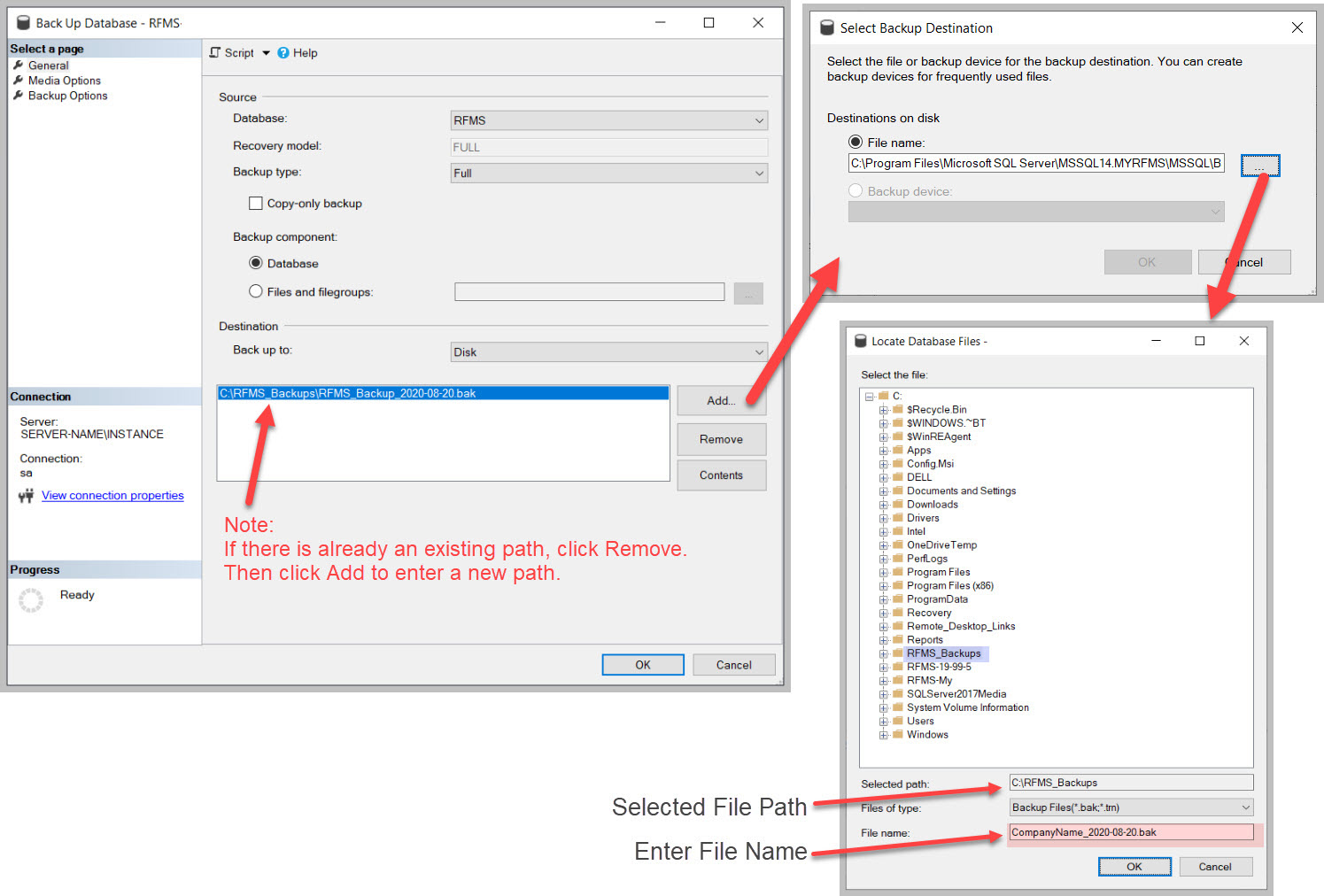
- Select OK to start the backup process.
- When backup is complete a screen like below will pop up. Select OK to complete the backup.

- To locate your database backup file, go to the location specified in the Destination field (Step 3).
If you are sending this backup to RFMS for review or testing, follow the instructions in this article, RFMS File Upload, for instructions on how to upload the file.
Section 2: Manual Restore of SQL Database
- On the server, open SQL Server Management Studio and select Connect when prompted.
NOTE: Make sure that the correct server name and instance (if needed) is in the Server Name field.
- In the left panel, right-click Databases and select Restore Database.

- On the General page, select Device under the Source
- Click the browse (...) button to open the Select backup devices dialog box. Click Add and navigate to your backup. Click OK after you have selected your disk backup file.
- Click OK to return to the General page.

- In the Destination section, the Database box is automatically populated with the name of the database to be restored. To create a new database, enter the new name in the Database box.

- Click Files in the Select a page panel on the left.
-
Check the Restore As option to ensure the locations and file names are correct for the mdf and ldf files.

- Click Options in the Select a page panel on the left.
- In Restore Options, select Overwrite the existing database (WITH REPLACE)
- Under the Tail-log backup section, if checked, uncheck "Take tail-log backup before restore"
Important: Not unchecking this option can result in an existing database changing to the restoring state.
-
VERY IMPORTANT: Go back to the General page and make sure the Destination Database Name is still correct. If it is not correct, reenter the correct name.

Note: Make sure you are restoring to the correct database name. Accidentally restoring a backup file to the wrong database will overwrite that database and result in loss of all its data. Again, RFMS recommends these processes be performed by a qualified SQL technician.
- Click OK to process the restore.
- When finished a box will display to let you know if the restore completed correctly or not.

Comments
Article is closed for comments.